


By Sudeep | BestBattery.in
A 3 kW off-grid solar system can be a practical solution for a home, small office, shop, farm house or rural property where grid electricity is unavailable, unreliable or too expensive to depend on completely.
Unlike a grid-connected solar system, an off-grid system is designed to work independently. Solar panels generate electricity during the day, the solar charge controller manages battery charging, and the inverter supplies usable AC power to appliances. The battery becomes the critical component when the sun is weak or unavailable.
But there is one important point that many buyers miss: 3 kW refers primarily to the inverter or solar-generation capacity; it does not automatically mean that the system can run a 3 kW load continuously for 24 hours.
In this guide, I will explain how I would approach the design of a 3 kW off-grid system, what components are required, how to connect them, what battery capacity makes sense, and how much electricity you can realistically expect in summer, winter and rainy weather across different parts of India.
India receives roughly 4–7 kWh of solar energy per square metre per day across most regions, although actual solar generation varies significantly with location, season, temperature, cloud cover, shading and system losses.
What Is a 3 kW Off-Grid Solar System?
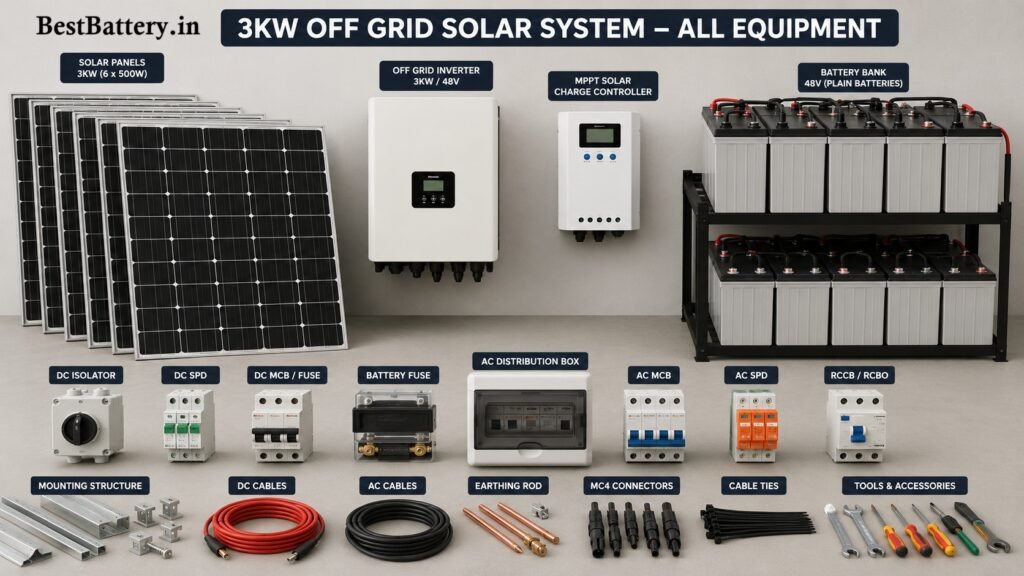
A typical 3 kW off-grid system consists of:
- Approximately 3 kWp of solar panels
- A 3 kW pure sine-wave off-grid inverter
- MPPT solar charge controller
- 48/51.2 V battery bank
- DC protection devices
- AC protection devices
- Mounting structure
- Solar cables and connectors
- Earthing and lightning protection
- Monitoring system
A practical configuration could be:
| Component | Recommended specification |
|---|---|
| Solar panels | 3 kWp |
| Example panel configuration | 6 × 500 W |
| Inverter | 3 kW / approximately 3 kVA pure sine wave |
| System voltage | 48 V / 51.2 V |
| Battery | 5.12 kWh minimum; 10.24 kWh preferred |
| Battery chemistry | LiFePO4 recommended |
| MPPT capacity | Around 80 A or according to inverter specification |
| Solar DC voltage | According to MPPT input range |
| Solar structure | Galvanised steel/aluminium |
| Earthing | Proper DC, AC and equipment earthing |
| Protection | DC isolator, DC SPD, MCB/fuse, AC MCB, RCCB/RCBO and AC SPD |
The exact voltage and current ratings must always be selected according to the inverter and panel datasheets.
Step 1: Calculate Your Actual Electrical Load
Before buying panels or batteries, calculate your load.
Suppose a small house has:
| Appliance | Quantity | Power | Daily use | Energy/day |
|---|---|---|---|---|
| LED lights | 6 | 10 W | 5 h | 300 Wh |
| Ceiling fans | 3 | 70 W | 8 h | 1,680 Wh |
| TV | 1 | 100 W | 4 h | 400 Wh |
| Refrigerator | 1 | 150 W average | 10 h equivalent | 1,500 Wh |
| Wi-Fi/router | 1 | 15 W | 10 h | 150 Wh |
| Laptop | 1 | 60 W | 5 h | 300 Wh |
| Miscellaneous | — | — | — | 300 Wh |
This example consumes approximately 4.6 kWh per day.
However, appliances do not all operate simultaneously.
That distinction is important.
You need to calculate two things:
1. Daily energy requirement
This is measured in kWh or units.
If your home consumes 5 kWh per day, your solar system must produce enough energy to cover the appliances plus charging and conversion losses.
2. Maximum simultaneous load
This determines the inverter size.
For example, if your maximum simultaneous load is approximately 2.2 kW, a 3 kW inverter provides reasonable operating capacity.
Motors and compressors require additional starting power, so refrigerators, pumps and other inductive appliances need special consideration.
Step 2: Select the Solar Panel Capacity
For a system marketed as a 3 kW solar system, one straightforward configuration is:
6 × 500 W solar panels = 3,000 W = 3 kWp
You could also use different combinations such as:
- 5 × 600 W = 3 kWp
- 6 × 500 W = 3 kWp
- 7 × 450 W = 3.15 kWp
- 8 × 400 W = 3.2 kWp
In real installations, slightly oversizing the PV array can be useful because panels rarely deliver their nameplate rating continuously.
Panel output is affected by:
- Solar irradiation
- Module temperature
- Dust
- Cable losses
- MPPT efficiency
- Panel orientation
- Shading
- Ageing
- Cloud cover
Therefore, seeing a 3 kW panel array produce exactly 3 kW throughout the day is not realistic.
The Ministry of New and Renewable Energy notes that India has high solar potential, with most areas receiving 4–7 kWh/m²/day.
Step 3: Choose the Right Inverter
For a 3 kW off-grid system, I recommend looking for a 3 kW pure sine-wave off-grid inverter with an integrated MPPT, where possible.
Important specifications include:
- Continuous output: 3,000 W
- Pure sine-wave output
- 230 V AC
- 50 Hz
- 48 V or 51.2 V battery compatibility
- Integrated MPPT
- Sufficient PV input voltage range
- Sufficient PV input current
- Low-voltage battery protection
- Overload protection
- Short-circuit protection
- Temperature protection
- Battery charging control
- LCD/app monitoring, if required
Don’t select an inverter only because its label says “3 kW.”
Check the continuous output rating, surge rating, MPPT voltage range and maximum PV input power.
For example, a refrigerator may consume only 150 W while running but require a substantially higher starting surge.
Step 4: Select the Battery
The battery is arguably the most important component in an off-grid system.
For a 48 V system:
Option 1: 51.2 V 100 Ah LiFePO4
51.2 V × 100 Ah =
5.12 kWh nominal storage
At approximately 90% usable depth of discharge:
5.12 × 0.90 = 4.61 kWh usable
After inverter and other losses, the useful AC energy will be lower.
This can work for a relatively small essential-load system.
Option 2: 51.2 V 200 Ah LiFePO4
51.2 V × 200 Ah =
10.24 kWh nominal storage
At 90% usable depth of discharge:
10.24 × 0.90 = 9.22 kWh usable DC energy
This is a much more comfortable battery size for a serious off-grid home.
For customers who want dependable overnight operation, I generally prefer the 10 kWh-class battery over trying to make a 3 kW system work with a very small battery.
Step 5: Why 48 V Is Better for a 3 kW System
At 3,000 W:
Current = Power ÷ Voltage
At 48 V:
3,000 ÷ 48 = approximately 62.5 A
At 24 V:
3,000 ÷ 24 = approximately 125 A
At 12 V:
3,000 ÷ 12 = 250 A
This is why a 48 V battery system is much more practical for a 3 kW off-grid installation.
Lower system voltage means much higher current, which increases cable size, voltage drop and losses.
For a 3 kW system, a 48/51.2 V architecture is therefore a sensible engineering choice.
Step 6: Configure the Solar Panels
Suppose your 500 W panel has approximately:
- Vmp: 40–42 V
- Voc: 48–50 V
- Imp: approximately 12 A
One possible configuration is:
3 panels in series × 2 parallel strings
This gives approximately:
- Vmp ≈ 120–126 V
- Voc ≈ 144–150 V
- Current ≈ 24 A
However, this is only an example.
The actual configuration must be calculated from the specific panel’s Voc, Vmp, temperature coefficient and the inverter’s MPPT voltage limits.
Do not blindly connect panels in series because the cold-weather Voc can rise significantly.
Step 7: Install the Mounting Structure
The panels should be mounted on a strong structure capable of handling:
- Wind
- Rain
- Panel weight
- Local environmental conditions
- Long-term corrosion
For most fixed installations in India, panels are generally oriented toward the south to maximise annual solar exposure, with tilt adjusted according to location and design objective.
Avoid placing panels where nearby:
- Buildings
- Trees
- Water tanks
- Poles
- Chimneys
- Parapet walls
can create shadows.
Even partial shading can significantly affect energy production, particularly when modules are connected in strings.
Step 8: Install DC Protection
The solar side should not simply be connected directly to the inverter.
Depending on the system architecture, protection may include:
- DC isolator
- String fuses
- DC SPD
- Appropriate DC-rated breakers
- MC4-compatible connectors
- Correctly sized solar DC cable
The protection devices must be rated for the actual DC voltage and current.
Never use an AC-rated switch as a substitute for a properly rated DC isolator.
Step 9: Install the Battery Protection
The battery requires appropriate protection as well.
A lithium battery system should have:
- Battery management system (BMS)
- Correct DC fuse/breaker
- Battery isolator
- Correct cable size
- Proper terminals
- Temperature protection where applicable
- Adequate ventilation and installation clearance according to manufacturer instructions
For lithium batteries, the BMS is an essential part of the system.
It can protect against conditions such as overcharge, over-discharge, excessive current and abnormal temperature.
Step 10: Install AC Protection
The inverter output should feed an appropriate AC distribution board.
A typical arrangement may include:
Inverter → Main AC protection → RCCB/RCBO → MCBs → Individual circuits
Depending on the installation, AC surge protection and proper earthing should also be provided.
Important circuits such as:
- Refrigerator
- Lights
- Fans
- Internet
- Security systems
can be separated from heavy loads.
This is particularly useful in an off-grid system because it allows the homeowner to prioritise essential loads when battery energy is low.
Step 11: Complete Earthing and Lightning Protection
Earthing should never be treated as an optional accessory.
A solar installation may require appropriate earthing for:
- Solar module frames
- Mounting structure
- Inverter
- AC system
- DC protection system
Lightning and surge protection should be designed according to the site, system configuration and applicable electrical standards.
For commercial or permanent residential installations, have the installation inspected by a qualified electrical professional.
Step 12: Commission the System
Before switching the system on, check:
- Panel polarity
- String voltage
- Open-circuit voltage
- Cable polarity
- Battery polarity
- Battery voltage
- Earthing
- DC isolators
- AC MCBs
- Inverter settings
- Battery chemistry setting
- Charging voltage
- Low-voltage cutoff
- Maximum charging current
- Maximum PV input
- Load output
Only after these checks should the system be commissioned.
How Much Electricity Can a 3 kW Solar System Generate?
This is where expectations need to be realistic.
A 3 kWp array does not produce 3 kW × 24 hours.
A useful engineering approximation is:
Daily AC energy ≈ PV capacity × equivalent peak-sun-hours × system efficiency
If we assume approximately 78% overall usable conversion after normal system losses:
For example:
3 kW × 5 peak-sun-hours × 0.78
= 11.7 kWh/day
This is an estimate, not a guarantee.
Actual generation changes every day.
Expected 3 kW Generation in Different Parts of India
The following table provides practical planning ranges for a well-oriented, unshaded 3 kWp system.
These are engineering estimates for planning, not guaranteed output figures. Local weather, roof orientation, temperature, dust and shading can move actual production substantially.
| Region | Summer/day | Winter/day | Rainy season/day |
|---|---|---|---|
| Rajasthan & Gujarat | 11–14 kWh | 10–14 kWh | 6–9 kWh |
| Delhi, Punjab & Haryana | 11–14 kWh | 7–11 kWh | 5–8 kWh |
| Madhya Pradesh & Uttar Pradesh | 10–13 kWh | 9–12 kWh | 5–8 kWh |
| Maharashtra & Telangana | 10–14 kWh | 10–13 kWh | 6–9 kWh |
| Karnataka, Andhra Pradesh & Tamil Nadu | 10–14 kWh | 10–13 kWh | 6–9 kWh |
| Kerala & high-rainfall areas | 8–11 kWh | 8–11 kWh | 4–7 kWh |
| Northeast India | 7–11 kWh | 8–12 kWh | 3–7 kWh |
The ranges illustrate why location is just as important as panel capacity.
MNRE states that clear sunny weather is experienced for roughly 250–300 days in most parts of India, while annual solar radiation varies by region.
Summer Generation: Is It Always the Highest?
Not necessarily.
People often assume that hotter weather automatically means more solar electricity.
That is not correct.
Solar panels require sunlight, not heat.
As module temperature rises, electrical efficiency generally decreases. Therefore, an extremely hot afternoon can produce less power than expected despite strong sunlight.
In northern India, summer can provide excellent solar availability, while in some southern and western locations the seasonal difference can be smaller.
The important metric is solar irradiation at the panel, not simply outdoor temperature.
Winter Generation
Winter performance can actually be excellent in areas with clear skies.
Cooler panel temperatures can improve module efficiency.
However, northern India can experience:
- Fog
- Smog
- Haze
- Shorter days
- Low-angle sunlight
These factors can significantly reduce production.
For example, a clear winter day in Rajasthan can produce excellent solar output, while a foggy winter morning in Delhi or Punjab may produce very little power until the haze clears.
Rainy Season Generation
Monsoon is the most unpredictable period.
A cloudy day can reduce solar generation dramatically.
A 3 kW system that produces 10–13 kWh on a good sunny day could produce only 3–7 kWh on a heavily overcast day.
This is why an off-grid system needs battery capacity and load management.
The objective should not be:
“My panels must produce the same amount every day.”
The objective should be:
“The total generation and battery storage should be sufficient to operate my essential loads reliably.”
MNRE also recognises the role of off-grid solar systems in areas where grid electricity is unavailable or unreliable.
How Much Backup Can a 10 kWh Battery Provide?
Suppose you install:
51.2 V × 200 Ah = 10.24 kWh
With approximately 90% usable capacity:
≈9.2 kWh usable DC energy
After inverter losses, assume approximately 8–8.5 kWh may be practically available for AC loads, depending on the equipment and operating conditions.
For example:
500 W average load
8 kWh ÷ 0.5 kW
= approximately 16 hours
1 kW average load
8 kWh ÷ 1 kW
= approximately 8 hours
2 kW average load
8 kWh ÷ 2 kW
= approximately 4 hours
These are simplified calculations.
Real backup time varies with inverter efficiency, battery temperature, discharge rate, battery condition and the actual load profile.
What Can a 3 kW Off-Grid System Run?
A properly designed 3 kW system can comfortably support many household essentials such as:
- LED lighting
- Ceiling fans
- Television
- Refrigerator
- Wi-Fi router
- Laptops
- Chargers
- Small appliances
- Some kitchen appliances
However, you should be careful with simultaneous heavy loads such as:
- Electric geyser
- Large water heater
- Electric oven
- Induction cooktop
- Air conditioner
- Large water pump
A 3 kW inverter is still a 3 kW inverter.
Installing a larger battery does not automatically increase the inverter’s maximum AC output.
If your home regularly requires 5–6 kW simultaneously, a 3 kW inverter is not the correct design.
A Practical 3 kW Configuration I Would Recommend
For a typical Indian off-grid home, my preferred starting specification would be:
Solar
3.0–3.3 kWp
Using six 500 W panels or slightly oversized equivalent capacity.
Inverter
3 kW pure sine-wave, 48/51.2 V off-grid inverter
Preferably with integrated MPPT.
Battery
10.24 kWh LiFePO4
51.2 V × 200 Ah.
Protection
- DC isolator
- DC SPD
- Appropriate string protection
- Battery fuse/breaker
- AC MCB
- RCCB/RCBO
- AC SPD
- Proper earthing
Monitoring
A good monitoring system should show:
- PV voltage
- PV current
- PV power
- Daily generation
- Battery voltage
- Battery state of charge
- Load consumption
- Charging status
- Fault history
This makes troubleshooting considerably easier.
Should You Choose Lead-Acid or Lithium Battery?
For a modern off-grid installation, I would generally favour LiFePO4 lithium batteries where the budget permits.
Lead-acid batteries can still make sense for cost-sensitive applications, but they generally require more attention to usable depth of discharge, installation and maintenance.
LiFePO4 offers advantages such as:
- Higher usable capacity
- Better cycle life
- Lower maintenance
- Better efficiency
- Higher usable depth of discharge
- More compact storage
However, the battery must have a properly engineered BMS and must be compatible with the inverter’s charging parameters.
What Happens During Three Consecutive Rainy Days?
This is the real test of an off-grid system.
Suppose your daily essential load is 5 kWh.
For three days:
5 × 3 = 15 kWh
You would need approximately 15 kWh of usable stored energy to completely cover those loads without meaningful solar contribution.
That means a 10 kWh nominal battery may not provide three days of autonomy.
This is why I recommend designing the system around essential loads and realistic autonomy, rather than simply buying a 3 kW inverter.
If long rainy-season autonomy is essential, the system may require:
- Larger battery
- Larger PV array
- Load reduction
- Generator backup
- Grid backup, if available
A 3 kW system is not automatically a three-day backup system.
Can We Oversize the Solar Panels?
In many off-grid installations, slightly oversizing the PV array can be useful, provided the inverter manufacturer permits the proposed PV input.
For example, a 3 kW inverter may sometimes be paired with more than 3 kWp of PV.
The benefit is better energy production during:
- Morning
- Afternoon
- Winter
- Cloudy conditions
But you must never exceed the inverter’s:
- Maximum PV power
- Maximum PV voltage
- Maximum PV current
The cold-weather string Voc calculation is especially important.
The Most Common Mistakes I See
Mistake 1: Buying the inverter first
Start with the load calculation.
Mistake 2: Installing an undersized battery
A 3 kW inverter with a tiny battery will not provide meaningful overnight backup.
Mistake 3: Ignoring rainy-season performance
Always design for the worst realistic solar period.
Mistake 4: Poor panel placement
Even partial shade can cause substantial losses.
Mistake 5: Using incorrect cables
DC systems can carry significant current. Cable size and voltage rating matter.
Mistake 6: No proper protection
DC isolation, surge protection, fusing and earthing are essential parts of a professional installation.
Mistake 7: Assuming “3 kW” means 72 kWh/day
A 3 kW system cannot produce 3 kW continuously for 24 hours.
Solar availability changes throughout the day.
How Much Electricity Does a 3 kW Off-Grid Solar System Generate in India?
A 3 kW off-grid solar system in India can typically generate around 8–14 units (kWh) of electricity per day, depending on the location, season, sunlight, panel orientation, shading, temperature and weather conditions.
In areas with strong sunlight such as Rajasthan and Gujarat, a well-installed 3 kW system may produce approximately 11–14 kWh per day during good summer or winter conditions. In Madhya Pradesh and Uttar Pradesh, around 9–13 kWh per day can be a reasonable planning range. During the monsoon, generation can fall to approximately 4–9 kWh per day, particularly during prolonged cloudy or rainy periods.
| Location/Region | Typical Daily Generation |
|---|---|
| Rajasthan & Gujarat | 11–14 units |
| Delhi, Punjab & Haryana | 7–14 units |
| Madhya Pradesh & Uttar Pradesh | 8–13 units |
| Maharashtra & Telangana | 10–14 units |
| Karnataka, Andhra Pradesh & Tamil Nadu | 10–14 units |
| Kerala | 4–11 units |
| Northeast India | 3–11 units |
These figures are planning estimates rather than guaranteed production. A 3 kW solar array can produce more electricity on a clear, sunny day and considerably less during heavy cloud cover or rain.
For an off-grid system, the electricity generated by the panels is used to power appliances and charge the battery. Therefore, actual usable electricity will also depend on battery charging losses, inverter efficiency and the home’s load profile.
In simple terms: a properly installed 3 kW off-grid solar system can often generate roughly 240–420 units per month under favourable conditions, but seasonal and weather-related variations can be significant.
Final Recommendation
A 3 kW off-grid solar system is a very useful size for a small-to-medium Indian home when it is designed around the actual load.
For a strong all-round configuration, I would start with:
3–3.3 kWp solar panels + 3 kW pure sine-wave inverter + 10.24 kWh LiFePO4 battery + proper DC/AC protection.
Such a system can commonly generate around 8–14 kWh per day depending on location and season, with significantly lower output possible during prolonged monsoon cloud cover.
The most important point is that there is no single generation figure for “India.”
Rajasthan, Gujarat, Madhya Pradesh, Delhi, Maharashtra, Tamil Nadu, Kerala and the Northeast all have different solar conditions.
Therefore, when designing an off-grid system, I recommend using three numbers:
Daily load + peak simultaneous load + required backup days.
Once those three numbers are known, panel capacity, inverter size and battery capacity can be selected logically rather than simply purchasing a package labelled “3 kW.”
India has a strong solar resource, and MNRE reports that most parts of the country receive around 4–7 kWh/m²/day of solar energy.
The technology is proven. The difference between a frustrating off-grid installation and a reliable one is usually proper sizing, correct installation and realistic expectations.
Frequently Asked Questions
Is a 3 kW solar system enough for a house?
It can be enough for a small or medium household with efficient appliances, provided the maximum simultaneous load stays within the inverter rating and the battery is appropriately sized.
How many units can a 3 kW solar system generate per day?
Depending on location, season and weather, approximately 8–14 kWh per day is a reasonable planning range for many Indian locations. Some days can be higher or lower.
What battery is best for a 3 kW off-grid system?
A 48/51.2 V LiFePO4 battery is a strong choice. A 5.12 kWh battery is a basic configuration, while 10.24 kWh provides substantially more practical overnight storage.
Can a 3 kW solar system run an AC?
It depends on the AC’s running and starting requirements and what other appliances are operating. A high-efficiency inverter AC may be possible, but the entire load profile must be checked before installation.
Can I use a 24 V battery with a 3 kW inverter?
It is technically possible with suitable equipment, but current becomes very high. A 48 V/51.2 V battery architecture is generally more practical for a 3 kW system.
Will the system work during rain?
Yes, but solar generation can fall substantially under heavy cloud cover. The battery supplies energy when solar production is insufficient.
How many solar panels are required for 3 kW?
Six 500 W panels provide exactly 3 kWp. The actual number depends on the wattage and electrical characteristics of the selected modules.
Is 3 kW inverter capacity the same as 3 kW solar capacity?
No. Inverter capacity refers to the AC power it can deliver, while PV capacity refers to the solar array’s rated DC capacity.
Is a 10 kWh battery enough for a whole night?
It depends on your overnight consumption. If the average AC load is 500 W, several hours of operation are possible. If the load is 2 kW, the same battery will discharge much faster.
What is the biggest factor affecting solar generation?
Solar irradiation is the biggest factor, but panel orientation, shading, temperature, dust, system losses and weather also have major effects.
Disclaimer
The generation figures, battery calculations and component specifications in this article are engineering estimates for educational and planning purposes. Actual solar generation and battery backup can vary according to geographical location, weather, panel orientation, tilt, shading, module temperature, dust, cable losses, inverter efficiency, battery condition, appliance load and installation quality.
Electrical installation, earthing, protection, battery integration and commissioning should be carried out by a qualified professional in accordance with applicable Indian electrical standards, manufacturer instructions and local regulations.
Before purchasing a complete system, always verify the latest technical datasheets for the exact solar panels, inverter, battery, protection equipment and mounting structure being installed.