


By Sudeep Srivastava
Introduction: Start With Your Load, Not the Battery
When a customer tells me, “I need a battery for my home,” my first question is never, “How many Ah do you want?” I first ask what they want the battery to run, for how long, and how often they experience power cuts.
That distinction is important because an inverter battery should be selected from the electrical load and required backup time, not from a guess or a neighbour’s recommendation. A 150 Ah battery may be more than enough for one home and completely inadequate for another.
In my experience working with electrical and backup-power systems, most battery-selection mistakes happen because people confuse inverter capacity with battery capacity. The inverter is normally discussed in VA or kVA, while the battery is commonly specified in Ah. These are related, but they answer different questions.
The good news is that selecting the right battery is not complicated once you understand the basic calculation. You need to identify your actual load, estimate the backup duration, account for inverter efficiency and battery characteristics, and then choose an appropriate battery bank.
In this guide, I will walk through that process the way I would explain it to a homeowner: from making a load list to calculating watts, estimating backup time, understanding Ah, comparing tubular and lithium batteries, and avoiding common sizing mistakes.
1. Understand What an Inverter and Battery Actually Do
An inverter and a battery perform two different jobs. The battery stores electrical energy in DC form. The inverter converts that stored DC energy into AC electricity that your household appliances can use.
When the grid is available, the inverter may charge the battery and supply power to connected loads. During a power cut, it draws energy from the battery and converts it into usable AC power.
This creates two separate sizing questions. First, can the inverter handle the appliances you want to operate? Second, does the battery contain enough stored energy to operate those appliances for the required period?
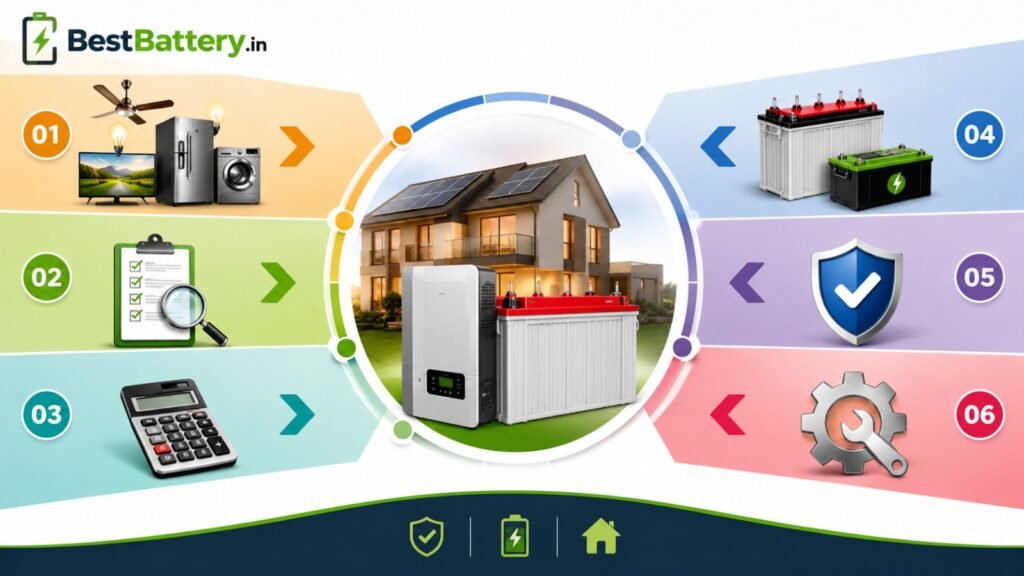
I always recommend separating essential loads from non-essential loads. Lights, fans, Wi-Fi, a television and perhaps a computer may be essential. A geyser, air conditioner, induction cooktop or large pump may need a much larger inverter and battery system.
This simple separation can dramatically reduce the battery capacity you need and therefore the installation cost.
2. Make a Home Load List in Watts
Before doing any battery calculation, write down the appliances you want to run during a power cut.
Do not simply count appliances. Find their approximate power consumption in watts. A practical example could be four LED bulbs at 10 W each, two fans at 70 W each, a Wi-Fi router at 10 W, a television at 100 W and a laptop at 50 W.
That gives 40 + 140 + 10 + 100 + 50 = 340 W of simultaneous running load.
Real appliances can vary considerably. Fans may consume less or more depending on the motor and speed. Modern televisions and laptops also have different consumption patterns. Appliance labels, manufacturer specifications or a plug-in power meter can provide better numbers than assumptions.
I strongly recommend measuring unusual or high-power appliances instead of relying on generic internet figures. Once you have a realistic wattage figure, the battery calculation becomes much more meaningful.
3. Calculate Your Required Backup Time
The next question is simple: how long do you want the system to operate during a power cut?
Suppose your essential load is 340 W and you want five hours of backup. Your basic energy requirement is 340 W × 5 hours = 1,700 Wh, or 1.7 kWh.
But we cannot simply divide 1,700 Wh by battery voltage and declare the result. There are losses in the inverter, and the usable portion of a battery depends on chemistry, operating conditions and recommended depth of discharge.
For a rough lead-acid calculation, one useful approach is:
Required battery Ah ≈ Load watts × Backup hours ÷ (Battery voltage × Inverter efficiency × Usable battery fraction).
Using 1,700 Wh, a 12 V system, 85% inverter efficiency and 80% usable battery capacity gives approximately 208 Ah.
That points toward a battery around the 200 to 220 Ah range for the assumed conditions. This is an engineering estimate, not a guarantee. Actual backup time changes with load, battery age, temperature, discharge rate and inverter behaviour.
4. Why Ah Alone Does Not Tell the Whole Story
Ampere-hours, or Ah, tell us about a battery’s charge capacity at a specified voltage and test condition. They are useful, but Ah should never be viewed in isolation.
For example, a nominal 12 V, 150 Ah battery has approximately 12 × 150 = 1,800 Wh of nominal stored energy. However, the amount that can actually reach your appliances will be lower because of conversion losses and battery operating limits.
This is why two batteries with the same Ah rating can deliver different real-world results. Chemistry, discharge rate, temperature, age and battery design all matter.
The same principle becomes even more important when comparing lead-acid and lithium batteries. A lithium battery may have a smaller nominal Ah rating while providing a larger proportion of its stored energy as usable capacity.
So when someone asks me, “Should I buy 150 Ah or 200 Ah?”, I ask: “150 or 200 Ah at what voltage, what chemistry, what usable depth of discharge and for what load?”
That is the difference between reading a battery label and actually sizing an energy-storage system.
5. Choosing Between 12 V, 24 V and 48 V Battery Systems
Small residential backup systems can use 12 V batteries, while larger systems often use 24 V or 48 V battery banks.
For a given power level, increasing system voltage reduces the current required from the battery. For example, a 1,000 W load theoretically draws about 83 A from a 12 V battery, about 42 A at 24 V and about 21 A at 48 V, before accounting for inverter losses.
This is one reason higher-voltage battery systems become attractive as system power increases. However, voltage is not something you should select independently. Your inverter must be designed for the battery-bank voltage, and batteries connected in series or parallel must be configured correctly.
A common mistake is mixing batteries of different ages, capacities or conditions. In a battery bank, consistency matters. Follow the manufacturer’s series and parallel configuration limits and use compatible batteries.
For larger homes, solar systems and high-power backup requirements, I recommend having the complete inverter-battery architecture designed rather than simply adding batteries until the desired backup time appears.
6. Tubular Lead-Acid vs Lithium for Home Backup
For years, tubular lead-acid batteries have been the standard choice for Indian inverter systems. They remain relevant because they are widely available, familiar to installers and often have an attractive initial purchase price.
They do, however, require more maintenance and installation consideration than many modern lithium systems. Ventilation, water maintenance for applicable batteries, charging behaviour and available installation space all matter.
Lithium batteries, particularly LFP systems, are increasingly attractive for homeowners who want higher usable capacity, compact installation and long cycle life. They also typically require less routine maintenance.
But lithium should not be treated as a universal upgrade. The inverter must support the battery’s voltage and charging requirements, and the battery should have an appropriate battery-management system.
When I compare the two for a customer, I look beyond the purchase price. I consider expected cycling, usable capacity, installation space, maintenance, warranty, service support and total ownership cost.
7. Account for High-Load Appliances and Starting Current
One of the biggest sizing mistakes is calculating only the average running wattage.
Some appliances draw a higher starting current when their motors or compressors begin operating. Refrigerators, pumps, air conditioners and certain other motor-driven loads can create a temporary surge.
The inverter must be capable of handling this demand. A battery also needs to supply the current without excessive voltage drop. This is why a system that looks adequate on paper can sometimes shut down when a refrigerator or pump starts.
When I design or assess a backup system, I separate continuous load from starting or surge demand. I also look at the inverter’s continuous power rating and surge capability.
Do not assume that a 1,000 VA inverter can comfortably run every appliance whose calculated wattage happens to be below 1,000 W. VA, watts, power factor and surge capability all have to be considered.
8. A Practical Battery-Capacity Example
Assume your essential backup load is approximately 500 W and you want four hours of backup. The AC energy requirement is 500 × 4 = 2,000 Wh.
If we assume inverter efficiency of 85% and a usable battery fraction of 80%, the battery must provide approximately 2,000 ÷ (0.85 × 0.80) = 2,941 Wh.
At a 12 V nominal battery-bank voltage, that corresponds to roughly 2,941 ÷ 12 = 245 Ah.
In practice, you would not buy a battery based on the exact calculated number. You would select an available, suitable capacity with some margin and verify the inverter’s supported configuration.
If the same requirement were built around a 24 V system, the corresponding nominal Ah would be about half, because voltage is doubled. The energy requirement has not changed; the Ah representation has.
This example shows why saying “I need a 250 Ah battery” without discussing voltage and load is incomplete.
9. How Battery Age and Temperature Affect Backup
A new battery and an older battery do not necessarily deliver the same backup time.
Lead-acid batteries gradually lose usable capacity with age and operating conditions. Repeated deep discharge, inadequate charging and high temperatures can accelerate degradation.
Temperature also matters. Battery performance is affected by the environment, and excessive heat can shorten service life. This is particularly relevant in India, where summer temperatures can become severe.
Lithium batteries also have operating temperature limits and should have appropriate temperature monitoring and protection through the BMS.
This is why I advise customers to leave reasonable design margin. If your calculated requirement is right at the battery’s theoretical limit, real-world ageing can make the system feel undersized sooner.
Good charging practices, correct inverter settings and regular inspection can help maintain performance. A battery is not a one-time purchase that can simply be ignored after installation.
10. Common Battery-Sizing Mistakes I See
The first mistake is copying a neighbour’s setup. Their load and backup requirement may be completely different.
The second is buying the largest battery that fits the budget without checking inverter compatibility. More battery capacity is not automatically better if the inverter cannot charge or manage the battery correctly.
The third is ignoring surge loads. A refrigerator or pump may cause an inverter to trip even when the average wattage appears acceptable.
The fourth is calculating backup from nominal Ah without accounting for inverter losses and usable battery capacity.
The fifth is mixing incompatible batteries in a bank. Age, capacity, chemistry and manufacturer specifications should be considered before batteries are connected together.
The sixth is putting the battery in a hot or unsuitable location.
Finally, many homeowners focus entirely on initial cost. I prefer to calculate the expected value over the battery’s service life, including maintenance, replacement frequency, usable capacity and warranty.
11. My Practical Formula for Selecting an Inverter Battery
My basic process is simple.
Step one: list every appliance you want to operate during a power cut.
Step two: record the wattage of each appliance and calculate the simultaneous running load.
Step three: identify appliances with motors or compressors and check starting requirements.
Step four: decide the required backup duration.
Step five: calculate energy demand in watt-hours by multiplying watts by hours.
Step six: account for inverter efficiency and the battery’s usable capacity.
Step seven: select the battery-bank voltage and confirm that the inverter supports it.
Step eight: choose a commercially available battery capacity with a sensible margin.
Step nine: verify charging current, BMS communication where applicable, cable sizing, protection and installation requirements.
Step ten: check the warranty and after-sales support.
This process works whether you are selecting a conventional inverter battery for basic home backup or designing a more advanced solar-plus-storage system.
12. Final Recommendation: Size the System Around Your Real Life
The right inverter battery is not necessarily the biggest battery, the cheapest battery or the battery with the highest Ah number.
It is the battery that can reliably deliver the energy your essential appliances need for the amount of time you actually require, while working within the inverter’s electrical limits.
For a small home with lights, fans, Wi-Fi and a television, a modest battery system may be sufficient. A home that wants to operate refrigerators, pumps, computers and multiple fans for many hours will need a substantially larger system.
If you are installing solar, the calculation becomes even more important because the battery is no longer only an emergency backup device. It can become a daily energy-storage system.
My strongest advice is to calculate before you buy. Write down your loads, measure where possible, determine the required backup time and then select the inverter and battery as one coordinated system.
At Best Battery, that is the approach I believe homeowners should take. A good backup system should not simply work on the day it is installed. It should continue delivering predictable performance through real power cuts, changing loads, summer heat and years of use.
When the battery is correctly sized, the result is not just longer backup. It is better reliability, better value and fewer unpleasant surprises when the electricity actually goes out.
Disclaimer
This article is for general educational and informational purposes only. Battery capacity, inverter sizing, backup time and electrical-system requirements vary according to appliance loads, battery chemistry, inverter efficiency, operating conditions, installation design and manufacturer specifications. The calculations shown are illustrative estimates and should not be treated as a substitute for a site-specific electrical assessment. High-power appliances, motor loads, solar systems and battery banks should be designed and installed by a qualified electrical professional in accordance with applicable safety requirements and manufacturer instructions. Best Battery and the author are not responsible for losses, equipment damage, injury or other consequences resulting from applying the information without appropriate professional verification.